Showing posts with label Evaluate. Show all posts

Monday, March 14, 2011

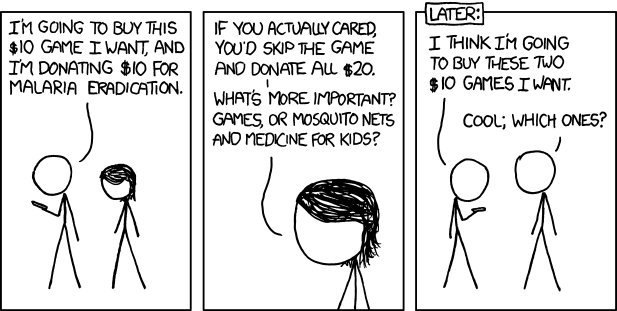
XKCD - Charity

I'm excited to have a shout out to one of my favorite comics - XKCD, "a webcomic of romance, sarcasm, math, and language".


Above is XKCD's most recent Friday webcomic (they post every Monday, Wednesday and Friday). Titled "Charity", I think it highlights a delicate issue.

What's the best way to raise money for a 'good cause'?

I know a ton of people, myself even occasionally being one of them, that are proud of a purchase that donated some of the proceeds to an organization. Some benefits of this are fairly clear: it's a product that can be appreciated by the consumer and works as publicity. However, I do believe it can be used as a cover.

Take a moment. Ask yourself if you have any organizations that you care about. Have you ever donated something, be it time or money, without expecting something in return? Now ask yourself if you've ever donated to a 'random' charity, one that you weren't personally attached to, without receiving some token? I wouldn't be surprised if there were quite a few yes-es, but I don't think anyone would blame me for asking this question and expecting some no-s either.

There's underlying incentives for people to take certain actions within our culture. Whether they're implicit or explicit can vary, but to be successful when fund raising there becomes a need to have a gimmick of some sorts. I'm not saying it's bad; as I said, I can be a proud owner of some of these items. They're enjoyable, can spread the word about a certain cause, and will get some people to give money who otherwise wouldn't have. At the same time, I can't help but dwell on that last point. The people who wouldn't have donated otherwise. With that, it still makes me wonder, how many people go beyond this first level of donations? I would imagine not enough.

Don't buy something that claims to donate to charity expecting to make a huge difference. It's not that simple. If you really want to feel proud, take the extra step to follow through. Do something because you believe in the cause, not always because you can get something snazzy out of it.

One of my friend's favorite charities is the organization Falling Whistles, which raises awareness about, and aid for, child soldiers. Buying one of the whistles to wear around one's neck is the expected way to donate. They certainly encourage it, using it as a sign of protest. An outcry. This is a great example of when purchasing something can be incredibly generous and helpful. In the end though, how many people buy more than one - to give away to friends? How many will donate money in addition to buying one?

How often is charity selfish?

Sunday, February 13, 2011

The Venezuelan Consulate & Other Model UN Tidings

Depending on how frequently you read my blog, you may or may not know that I went to a Model United Nations conference a week or so ago. I hope the topic isn't stale, but there are a few things I needed to take a moment to reflect on before blogging for 'the world' to see.

The logistics you need to know:
I represented a delegate from Venezuela. During the conference, which was downtown at the Palmer House, we attended committee where I discussed the ins &outs of cyberlaw.

Although my initial attempts at passing my own resolution failed miserably, I was able to pass an amendment to another's. Instead of a government having the right to regulate internet content that "facilitates conflict", I convinced the majority that a government must reserve that right for anything that "threatens to facilitate conflict." One word. One word that completely changes the meaning of the entire clause. All I can say is seeing the delegates from North Korea, China, Egypt & Venezuela high five probably should have tipped off more nations of our shenanigans.

Amidst this tomfoolery, my class was fortunate enough to meet with the Venezuelan consulate based in Chicago. The consul official opened with a powerpoint (or rather, he was supposed to open with a powerpoint but waited ten minutes instead because of technical issues). He dispelled interesting information I didn't know - such as the three tiered health care system in Venezuela. What was most interesting, was his different take on the information I did 'know.' My perception of Venezuela's views on cyberlaw were less than democratic with a pretty heavy pro-regulation stance. The Venezuelan consul official, however, was very adamant about distinguishing Venezuela's government from Egypt's. He highlighted how many elections each country has had in the past ten or so years. Egypt's one to Venezuela's ten. Venezuela even had an opposing party in the last election.

That sounds a lot better than how the U.S. media portrays Chavez's presidency. But, does it change anything? How much can the way you frame information change how it's weighed?

I was able to pass my amendment because I controlled how it was viewed. I said there was a flaw in the previous wording because having to wait until conflict actually broke out would be inhuman. If you knew something was dangerous to your citizens' well being, why must you wait for it to hurt them before you can act out against it? Adding just one word rectified this problem. Heck, that sounded much better than: we need more power to be able to control any and all content we think may go against the interests of our nation.

By comparing Venezuela to Egypt, the consular official controlled the scenario; he established a line in the sand of what was an agreed upon dictatorship and why Chavez is far from that threshold. He made his job easier rather than if he had to defend why Venezuela is as pro- free speech, rainbows, and hugs as the United States.

I will admit, the consular official got me thinking, and that is something I can always respect. He also encouraged questions because Venezuela loves to get to the heart of debate (as he put it). This rings true with Venezuela's involvement in the World Bank - where they don't sign much of anything, but they make enough noise to get to deeper issues and concerns.

With the Venezuelan consulate as inspiration - fire away with the questions. If you're feeling adventurous and want to ask something not related to this particular post, comment away and I might write my next blog post for you!

(Also - check out my friend Whimsy's blog. Here is a related post on the Model UN conference if I sparked your interest.)

Tuesday, December 14, 2010

Handlebars

Today in English class we discussed the us-them dichotomy. I'm not sure if my readers have had much discussion in the creation and existence of the "other" (be it through debate, class, or free reading), but hopefully this isn't too complicated.

On almost any conceivable scale, humans create a forced dichotomy - sometimes as 'small' as an individual scale of 'they don't listen to the pop music I like, they're emo" to entire cultures judging one another such as some Americans being so ready to think of all Muslims as the 'enemy'.

These dichotomies are dangerous and at the very least, greatly limit the potential for valuable life experiences. Arguably, they will always exist to some extent (people will always try to fill the void they subconsciously feel in understanding who they are themselves). However, we should try to recognize them. Recognize them to overcome the biases they create.

To end/your challenge -
Here's a music video by the Flobots. The song is entitled Handlebars.
At the beginning two children are friends. At the end, well...you'll see.
Discuss in the comments what role you think the us-them dichotomy plays in the video.


Here are lyrics for reference.

Tuesday, November 16, 2010

McDonalds - Maybe not poisoness?

I find myself being inspired by a lot of freakonomics posts...
So, needless to say, check out their blog if you haven't already!

As for my actual topic, as much as it pains me to type it, it's time to play devil's advocate for the fast food business.

I'm not sure what readers out there know about me but I am a vegetarian. I haven't had meat in a little over 4 years. Due to their meat-centric (or meat like substance-centric) menu, I haven't had much desire to dine at fast food chains such as McDonald's. On numerous occasions, I've also watched the movie Super Size Me (which you can conveniently watch on hulu if you click here). My favorite part of the movie is in the 'bonus features' in which Morgan Spurlock, director and star, seals away food in air tight containers. He takes items from McDonald's menu, and he takes their 'real restaurant' equivalent. While the 'normal' french fries grew mold in a day, McDonald's french fries went 7weeks with out a single sighted spore, until they were accidentally thrown away.

Well, with all those preservatives, I know had another reason to never eat at Mc-D's.

I assumed Spurlock's analysis on why the food hadn't molded was correct; it made sense and he had evidence right in front of him. It wasn't until I read this post that I even thought about an alternative explanation.

Now, I consider both to be partially right. I'm not sure how much surface area can explain the same disdain for mold the french fries had. I don't think we can entirely dismiss Spurlock's study. However, these new studies prove another factor, maybe the only factor in the hamburgers.

What I had to ask myself, and will suggest you do the same, is 'why was it so easy to believe Spurlock'? There's probably a few factors such as 1) it was presented in a documentary, which has professional connotations 2) Spurlock was very good in gathering sources when he was commenting on anything else in the film, and 3) it made sense. I can live with those assumptions, there's some logic. Some assumptions are necessary to drawn conclusions and make decisions.

The assumption I was disappointed in, was probably that Spurlock was right because he was proving how everyone else was wrong. Think about it. Spurlock was trying to prove the health dangers and general problems behind McDonald's food. He was already, in some fashion, trying to unveil assumptions.

Never let someone control how you see the world entirely. You may listen, and change your mind, based off people like Spurlock, but always question. You don't know the assumptions Spurlock's making, or even me.

Maybe McDonald's doesn't inject poison in it's food....however it still probably gives out heart attacks(but that's for another time).

Tuesday, October 12, 2010

Orleanna Price

Orleanna Price is a character in Barbara Kingsolver's The Poisonwood Bible. In the novel, the dynamic between her and her husband, Nathan Price, is one of complete domination. Nathan is controlling, and even scary.
"'Orleanna, shut up!' he yelled, grabbing her arm hard and jerking the plate out of her hand. He raised it up over her head and slammed it down hard on the table, cracking it right in two. The smaller half flipped upside down as it broke, and lay there dribbling black plantain juice like blood onto the tablecloth." p134


Why did Orleanna marry such a man?

She should have known better. She should have seen what her daughters walk on eggshells to avoid. As Rachel knows on page 133:
"Then Father's whole face changed and I knew he was going to use the special way of talking he frequently perpetuates on his family members, dogs that have peed in the house, and morons, with his words saying one thing that's fairly nice and his tone of voice saying another thing that is not."

However, the last sentence implicates slightly more. His words are nice while his tone is not. Is it possible Orleanna could have fallen in love with a different man?

It's a shame that some people believe every poor situation one encounters is directly related to a decision they have made. While I was reading, I perceived Orleanna as a human with weak character. She should have known not to marry him.
It is later that her decision to marry Nathan was revealed...if you could call it a decision. It was sudden. She was young and she didn't understand what was going on. She just barely picked up she was being courted.

Was she weak to not stop the marriage? To just 'go along with it' and agree to spend her life with him in the best of times and the worst of times? Maybe. But there's something to be said to grant Orleanna some benefit of the doubt.
Someone named Fnord wrote in this forum about possible reasons women choose to be with an abusive husband. There are the classic psychological reasons like 'she doesn't love herself' or 'her daddy was a bad bad man and that's all she knows.' Despite that some of these may be true, I don't see much of a discussion of 'she didn't know that version of him.'

There's so much we cannot possibly understand about abused women. Making an attempt is good because that's the only way we can help, but we can't make judgments and decide for them the psychological explanation in their past that made them fall in love with the wrong man. They've had too many things decided for them already.

Orleanna seems to deny she meets the points Fnord discusses.
"My downfall was not predicted. I didn't grow up looking for ravishment or rescue, either one. My childhood was a happy one in its own bedraggled way. My mother died when I was quite young, and certainly a motherless girl will come up wanting in some respects, but in my opinion she has a freedom unbeknown to other daughters. For every womanly fact of life she doesn't get told, a star of possibility still winks for her on the horizon." p192

Her perception of herself is that she would have more freedom because she would be able to avoid the expectations of a housewife.

Why does it matter why Orleanna married Nathan?
Because it could happen to you. Women who don't have 'scarred' or 'troubled' childhoods may assume that they have nothing to worry about. It is my fear that some of these women also believe it's their fault for not knowing before hand.
Orleanna is not to blame because Nathan stripped away her free will.

Everyone has a right to safe - physically and mentally. Everyone has a right to be happy.