On Monday, May 2nd, Westminster’s Daniel Taylor and Ellis Allen won the Tournament of Champions (TOC) in the policy debate division for the second year in a row. There is no doubt in my mind that as national champions, they will always be remembered and have some place in the debate community.
If you remember my first blog post, I mentioned how debate taught me about assumptions. As my last blog post, I want to talk about the other things debate has taught me over the years.
The TOC is the three day span every high school debater works toward. To qualify, each team had to do very well at two other tournaments earlier in the season. Just being qualified to attend is highly competitive. The teams that consistently did well worked extremely hard and dedicated themselves to the activity. Hard work paying off is something even non-debaters should be able to appreciate and even young debaters learn early on.
Arguably my most valued lesson from debate, however, took me the longest to learn. Determining who I am and what I stand for.
There have been scandals in the debate community, just as there are scandals in every activity. There are unethical actions one can take to either benefit their team or disadvantage their competition. Even if people choose not to fabricate or steal evidence, however, there's still tension of what you "have" to do to be the best. Considering how much work everyone does and how competitive every debate is, there's a false assumption of how someone has to act. No one has to be arrogant or condescending in the cross-examinations (questioning periods) to succeed. Daniel & Ellis exhibited that brilliantly.
The Julia Burke award acknowledges and exemplifies this. Julia was a debater who passed away in a car accident in 1998. According to their website, the award is to "recognize the high school policy debater who most closely upholds the combination of characteristics that Julia displayed in her love for the activity. These qualities include excellence in and passion for debate, a commitment to helping others, love and respect for the policy debate community and dedication to maintaining friendships despite the pressures of competition."
This year's recipient was Damien's Nadeem Farooqi. He deserves it immensely. Everyone loves Nadeem. I truly cannot think of a situation where I heard a bad word uttered about him.
Leaving debate I realized this is what was important to me. It's much more likely people will remember who you were, how you carried yourself as a person, rather than how many debates you won.
By all means, try your best in whatever activity you choose to participate in. But try in a way the builds your activity. Give back to it. Give it respect and leave the best person you can be.
Sunday, May 8, 2011

Sunday, April 17, 2011

Saturday, April 9, 2011
Experts
Last weekend I went to Atlanta for a debate tournament. I didn't grab any reading for the plane (my mistake), but I was able to steal a peak at a book one of my Freshman friends had on him, Passionate Declarations by Howard Zinn.
He was eager to share one particular passage:
'There is in orthodox thinking a great dependence on experts. Because modern technological society has produced a breed of experts who understand technical matters that bewilder the rest of us, we think that in matters of social conflict, which require moral judgments, we must also turn to experts.
There are two false assumptions about experts. One is that they see more clearly and think more intelligently than ordinary citizens. Sometimes they do, sometimes not. The other assumption is that there experts have the same interests as ordinary citizens, want the same things, hold the same values, and, therefore can be trusted to make decisions for all of us.'
I continued to read the next couple pages (5-7), which are highly relevant, but I omitted them for brevity's sake. Instead, I wanted to challenge my readers to come up with their own reasons why this reliance is bad/unnecessary.
However, to help inspire you, I'll reference another source Zinn mentions:
'In John Le Carre’s novel The Russia House, a dissident Russian scientist is assured that his secret document has been entrusted “to the authorities. People of discretion. Experts.” He becomes angry:
I do not like experts. They are our jailers. I despise experts more than anyone on earth…. They solve nothing! They are servants of whatever system hires them. They perpetuate it. When we are tortured, we shall be tortured by experts. When we are hanged, experts will hang us…. When the world is destroyed, it will be destroyed not by its madmen but by the sanity of its experts and the superior ignorance of its bureaucrats.'
What's persuasive to me here is not that experts are bad, but the over reliance on them is. Experts may try to advance their own agenda, whether they realize it or not. Their own agenda may not be "technical", but rather, it may be influenced by money or personal opinion. Zinn calls it the end of democracy, since it shifts decisions away from the public. A democratic society is one that has society make decisions, not an elite group of "experts."
Now, your turn. :]
He was eager to share one particular passage:
'There is in orthodox thinking a great dependence on experts. Because modern technological society has produced a breed of experts who understand technical matters that bewilder the rest of us, we think that in matters of social conflict, which require moral judgments, we must also turn to experts.
There are two false assumptions about experts. One is that they see more clearly and think more intelligently than ordinary citizens. Sometimes they do, sometimes not. The other assumption is that there experts have the same interests as ordinary citizens, want the same things, hold the same values, and, therefore can be trusted to make decisions for all of us.'
I continued to read the next couple pages (5-7), which are highly relevant, but I omitted them for brevity's sake. Instead, I wanted to challenge my readers to come up with their own reasons why this reliance is bad/unnecessary.
However, to help inspire you, I'll reference another source Zinn mentions:
'In John Le Carre’s novel The Russia House, a dissident Russian scientist is assured that his secret document has been entrusted “to the authorities. People of discretion. Experts.” He becomes angry:
I do not like experts. They are our jailers. I despise experts more than anyone on earth…. They solve nothing! They are servants of whatever system hires them. They perpetuate it. When we are tortured, we shall be tortured by experts. When we are hanged, experts will hang us…. When the world is destroyed, it will be destroyed not by its madmen but by the sanity of its experts and the superior ignorance of its bureaucrats.'
What's persuasive to me here is not that experts are bad, but the over reliance on them is. Experts may try to advance their own agenda, whether they realize it or not. Their own agenda may not be "technical", but rather, it may be influenced by money or personal opinion. Zinn calls it the end of democracy, since it shifts decisions away from the public. A democratic society is one that has society make decisions, not an elite group of "experts."
Now, your turn. :]
Monday, March 14, 2011
XKCD - Charity
I'm excited to have a shout out to one of my favorite comics - XKCD, "a webcomic of romance, sarcasm, math, and language".

Above is XKCD's most recent Friday webcomic (they post every Monday, Wednesday and Friday). Titled "Charity", I think it highlights a delicate issue.
What's the best way to raise money for a 'good cause'?
I know a ton of people, myself even occasionally being one of them, that are proud of a purchase that donated some of the proceeds to an organization. Some benefits of this are fairly clear: it's a product that can be appreciated by the consumer and works as publicity. However, I do believe it can be used as a cover.
Take a moment. Ask yourself if you have any organizations that you care about. Have you ever donated something, be it time or money, without expecting something in return? Now ask yourself if you've ever donated to a 'random' charity, one that you weren't personally attached to, without receiving some token? I wouldn't be surprised if there were quite a few yes-es, but I don't think anyone would blame me for asking this question and expecting some no-s either.
There's underlying incentives for people to take certain actions within our culture. Whether they're implicit or explicit can vary, but to be successful when fund raising there becomes a need to have a gimmick of some sorts. I'm not saying it's bad; as I said, I can be a proud owner of some of these items. They're enjoyable, can spread the word about a certain cause, and will get some people to give money who otherwise wouldn't have. At the same time, I can't help but dwell on that last point. The people who wouldn't have donated otherwise. With that, it still makes me wonder, how many people go beyond this first level of donations? I would imagine not enough.
Don't buy something that claims to donate to charity expecting to make a huge difference. It's not that simple. If you really want to feel proud, take the extra step to follow through. Do something because you believe in the cause, not always because you can get something snazzy out of it.
One of my friend's favorite charities is the organization Falling Whistles, which raises awareness about, and aid for, child soldiers. Buying one of the whistles to wear around one's neck is the expected way to donate. They certainly encourage it, using it as a sign of protest. An outcry. This is a great example of when purchasing something can be incredibly generous and helpful. In the end though, how many people buy more than one - to give away to friends? How many will donate money in addition to buying one?
How often is charity selfish?
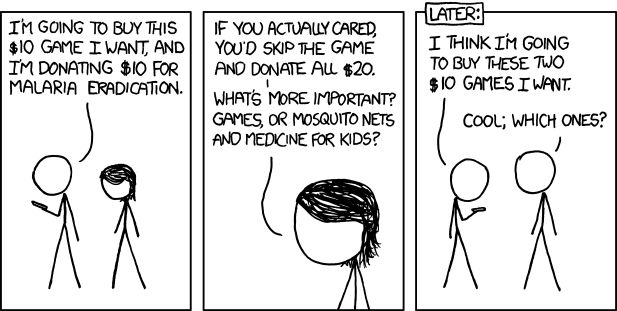
Above is XKCD's most recent Friday webcomic (they post every Monday, Wednesday and Friday). Titled "Charity", I think it highlights a delicate issue.
What's the best way to raise money for a 'good cause'?
I know a ton of people, myself even occasionally being one of them, that are proud of a purchase that donated some of the proceeds to an organization. Some benefits of this are fairly clear: it's a product that can be appreciated by the consumer and works as publicity. However, I do believe it can be used as a cover.
Take a moment. Ask yourself if you have any organizations that you care about. Have you ever donated something, be it time or money, without expecting something in return? Now ask yourself if you've ever donated to a 'random' charity, one that you weren't personally attached to, without receiving some token? I wouldn't be surprised if there were quite a few yes-es, but I don't think anyone would blame me for asking this question and expecting some no-s either.
There's underlying incentives for people to take certain actions within our culture. Whether they're implicit or explicit can vary, but to be successful when fund raising there becomes a need to have a gimmick of some sorts. I'm not saying it's bad; as I said, I can be a proud owner of some of these items. They're enjoyable, can spread the word about a certain cause, and will get some people to give money who otherwise wouldn't have. At the same time, I can't help but dwell on that last point. The people who wouldn't have donated otherwise. With that, it still makes me wonder, how many people go beyond this first level of donations? I would imagine not enough.
Don't buy something that claims to donate to charity expecting to make a huge difference. It's not that simple. If you really want to feel proud, take the extra step to follow through. Do something because you believe in the cause, not always because you can get something snazzy out of it.
One of my friend's favorite charities is the organization Falling Whistles, which raises awareness about, and aid for, child soldiers. Buying one of the whistles to wear around one's neck is the expected way to donate. They certainly encourage it, using it as a sign of protest. An outcry. This is a great example of when purchasing something can be incredibly generous and helpful. In the end though, how many people buy more than one - to give away to friends? How many will donate money in addition to buying one?
How often is charity selfish?
Tuesday, March 8, 2011
Women in Engineering
REPRESENT.
I had a visit to the University of Illinois this past weekend (since we had school off Monday for Polaski Day). I've been accepted into their Bioengineering program (yay me).
I had the usual admitted student presentation and tour; however, because I was a "Woman in Engineering" (let's call it WE to save my fingers) I had a few other opportunities. The most blatant was the WE luncheon. Now, I'm not one to turn down free food or free information, but at the same time, I felt odd being part of this group. They were very helpful but I thought it was odd to have a need for such a group.
I may be biased because I've grown up with only brothers and boy cousins, taking the selective math classes, in debate, and other stereotypical "guy things." I may also not understand since my major by far has the most women engineers in it - about 1/2. Other majors such as mechanical can have roughly only 10%.
With that said, let me reiterate: I liked going to this group. I like having it available just liked the Living-Learning Community of WIMSE. I think my opinion can be reflective of most Feminist views; having support systems aren't bad, especially if they make women feel more comfortable in such a male dominated domain. However, I hope one day it wouldn't be necessary to have such groups and select activities. Wouldn't it be nice for it to be normal to be a woman in engineering? Maybe we aren't at that point yet, but maybe not drawing attention to an issue will help eliminate it - not making it out of the ordinary, and not making the woman seem like they need added help.
Fire away the attacks or comments about anything related to this post!
I had a visit to the University of Illinois this past weekend (since we had school off Monday for Polaski Day). I've been accepted into their Bioengineering program (yay me).
I had the usual admitted student presentation and tour; however, because I was a "Woman in Engineering" (let's call it WE to save my fingers) I had a few other opportunities. The most blatant was the WE luncheon. Now, I'm not one to turn down free food or free information, but at the same time, I felt odd being part of this group. They were very helpful but I thought it was odd to have a need for such a group.
I may be biased because I've grown up with only brothers and boy cousins, taking the selective math classes, in debate, and other stereotypical "guy things." I may also not understand since my major by far has the most women engineers in it - about 1/2. Other majors such as mechanical can have roughly only 10%.
With that said, let me reiterate: I liked going to this group. I like having it available just liked the Living-Learning Community of WIMSE. I think my opinion can be reflective of most Feminist views; having support systems aren't bad, especially if they make women feel more comfortable in such a male dominated domain. However, I hope one day it wouldn't be necessary to have such groups and select activities. Wouldn't it be nice for it to be normal to be a woman in engineering? Maybe we aren't at that point yet, but maybe not drawing attention to an issue will help eliminate it - not making it out of the ordinary, and not making the woman seem like they need added help.
Fire away the attacks or comments about anything related to this post!
Tuesday, March 1, 2011
HoFlo
Homewood Flossmoore (affectionately dubbed HoFlo) is a high school located in the south side of Chicago. Saturday, it is where I ended a four year commitment to debate.
Now, the year is not over and I still have responsibilities to my other teammates; however, I myself will never have another debate round. High school feels like it's ending already.
Freshman year I had enrolled in "Argumentation and Debate 101" not knowing the grip it would hold on me. I used to do gymnastics for ten years, but I decided against joining the high school team because of the conflicts it had with something I was in for just a few months. High school seemed like it was full of making decisions and commitments. Now that my Model UN responsibilities are also quieting down with our last conference finished, it seems the end is in sight.
As cheesy as it sounds, I want to remind my readers that the end isn't "the end."
I had debate coaches approach me and apologize to me for my 4-2 showing, just missing having one more debate, and leaving on a slightly sour note.
If I didn't say it then, I'd like to say thank you to all of those coaches. Regardless of if I was on their team, they supported and helped me as I tried to be the best debater I could. I truly felt like part of the community that I loved so much, and with those ending remarks, I realized it won't ever be the end. I can choose to judge a tournament here or there, I can choose to visit. And, lastly, debate has been such a part of my life that it has helped change who I am. Although it may be subconsciously, debate will continue to influence my life even when I'm in college (although - thank goodness I won't be debating there!) :]
Now, the year is not over and I still have responsibilities to my other teammates; however, I myself will never have another debate round. High school feels like it's ending already.
Freshman year I had enrolled in "Argumentation and Debate 101" not knowing the grip it would hold on me. I used to do gymnastics for ten years, but I decided against joining the high school team because of the conflicts it had with something I was in for just a few months. High school seemed like it was full of making decisions and commitments. Now that my Model UN responsibilities are also quieting down with our last conference finished, it seems the end is in sight.
As cheesy as it sounds, I want to remind my readers that the end isn't "the end."
I had debate coaches approach me and apologize to me for my 4-2 showing, just missing having one more debate, and leaving on a slightly sour note.
If I didn't say it then, I'd like to say thank you to all of those coaches. Regardless of if I was on their team, they supported and helped me as I tried to be the best debater I could. I truly felt like part of the community that I loved so much, and with those ending remarks, I realized it won't ever be the end. I can choose to judge a tournament here or there, I can choose to visit. And, lastly, debate has been such a part of my life that it has helped change who I am. Although it may be subconsciously, debate will continue to influence my life even when I'm in college (although - thank goodness I won't be debating there!) :]
Sunday, February 13, 2011
The Venezuelan Consulate & Other Model UN Tidings
Depending on how frequently you read my blog, you may or may not know that I went to a Model United Nations conference a week or so ago. I hope the topic isn't stale, but there are a few things I needed to take a moment to reflect on before blogging for 'the world' to see.
The logistics you need to know:
I represented a delegate from Venezuela. During the conference, which was downtown at the Palmer House, we attended committee where I discussed the ins &outs of cyberlaw.
Although my initial attempts at passing my own resolution failed miserably, I was able to pass an amendment to another's. Instead of a government having the right to regulate internet content that "facilitates conflict", I convinced the majority that a government must reserve that right for anything that "threatens to facilitate conflict." One word. One word that completely changes the meaning of the entire clause. All I can say is seeing the delegates from North Korea, China, Egypt & Venezuela high five probably should have tipped off more nations of our shenanigans.
Amidst this tomfoolery, my class was fortunate enough to meet with the Venezuelan consulate based in Chicago. The consul official opened with a powerpoint (or rather, he was supposed to open with a powerpoint but waited ten minutes instead because of technical issues). He dispelled interesting information I didn't know - such as the three tiered health care system in Venezuela. What was most interesting, was his different take on the information I did 'know.' My perception of Venezuela's views on cyberlaw were less than democratic with a pretty heavy pro-regulation stance. The Venezuelan consul official, however, was very adamant about distinguishing Venezuela's government from Egypt's. He highlighted how many elections each country has had in the past ten or so years. Egypt's one to Venezuela's ten. Venezuela even had an opposing party in the last election.
That sounds a lot better than how the U.S. media portrays Chavez's presidency. But, does it change anything? How much can the way you frame information change how it's weighed?
I was able to pass my amendment because I controlled how it was viewed. I said there was a flaw in the previous wording because having to wait until conflict actually broke out would be inhuman. If you knew something was dangerous to your citizens' well being, why must you wait for it to hurt them before you can act out against it? Adding just one word rectified this problem. Heck, that sounded much better than: we need more power to be able to control any and all content we think may go against the interests of our nation.
By comparing Venezuela to Egypt, the consular official controlled the scenario; he established a line in the sand of what was an agreed upon dictatorship and why Chavez is far from that threshold. He made his job easier rather than if he had to defend why Venezuela is as pro- free speech, rainbows, and hugs as the United States.
I will admit, the consular official got me thinking, and that is something I can always respect. He also encouraged questions because Venezuela loves to get to the heart of debate (as he put it). This rings true with Venezuela's involvement in the World Bank - where they don't sign much of anything, but they make enough noise to get to deeper issues and concerns.
With the Venezuelan consulate as inspiration - fire away with the questions. If you're feeling adventurous and want to ask something not related to this particular post, comment away and I might write my next blog post for you!
(Also - check out my friend Whimsy's blog. Here is a related post on the Model UN conference if I sparked your interest.)
The logistics you need to know:
I represented a delegate from Venezuela. During the conference, which was downtown at the Palmer House, we attended committee where I discussed the ins &outs of cyberlaw.
Although my initial attempts at passing my own resolution failed miserably, I was able to pass an amendment to another's. Instead of a government having the right to regulate internet content that "facilitates conflict", I convinced the majority that a government must reserve that right for anything that "threatens to facilitate conflict." One word. One word that completely changes the meaning of the entire clause. All I can say is seeing the delegates from North Korea, China, Egypt & Venezuela high five probably should have tipped off more nations of our shenanigans.
Amidst this tomfoolery, my class was fortunate enough to meet with the Venezuelan consulate based in Chicago. The consul official opened with a powerpoint (or rather, he was supposed to open with a powerpoint but waited ten minutes instead because of technical issues). He dispelled interesting information I didn't know - such as the three tiered health care system in Venezuela. What was most interesting, was his different take on the information I did 'know.' My perception of Venezuela's views on cyberlaw were less than democratic with a pretty heavy pro-regulation stance. The Venezuelan consul official, however, was very adamant about distinguishing Venezuela's government from Egypt's. He highlighted how many elections each country has had in the past ten or so years. Egypt's one to Venezuela's ten. Venezuela even had an opposing party in the last election.
That sounds a lot better than how the U.S. media portrays Chavez's presidency. But, does it change anything? How much can the way you frame information change how it's weighed?
I was able to pass my amendment because I controlled how it was viewed. I said there was a flaw in the previous wording because having to wait until conflict actually broke out would be inhuman. If you knew something was dangerous to your citizens' well being, why must you wait for it to hurt them before you can act out against it? Adding just one word rectified this problem. Heck, that sounded much better than: we need more power to be able to control any and all content we think may go against the interests of our nation.
By comparing Venezuela to Egypt, the consular official controlled the scenario; he established a line in the sand of what was an agreed upon dictatorship and why Chavez is far from that threshold. He made his job easier rather than if he had to defend why Venezuela is as pro- free speech, rainbows, and hugs as the United States.
I will admit, the consular official got me thinking, and that is something I can always respect. He also encouraged questions because Venezuela loves to get to the heart of debate (as he put it). This rings true with Venezuela's involvement in the World Bank - where they don't sign much of anything, but they make enough noise to get to deeper issues and concerns.
With the Venezuelan consulate as inspiration - fire away with the questions. If you're feeling adventurous and want to ask something not related to this particular post, comment away and I might write my next blog post for you!
(Also - check out my friend Whimsy's blog. Here is a related post on the Model UN conference if I sparked your interest.)
Monday, February 7, 2011
Movie Recommendations; Part 1
I wasn't sure I was going to write this post at first, but after noticing a comment by Navya & a few other events, it was pretty much fate (dramatic? but of course).
I was sitting in my hotel room this weekend, I was downtown for a Model UN conference in Chicago, when The Dark Knight came on the t.v. Can you believe two/three of my roommates haven't seen it? Shame on them (I even hope they're reading this right now to be able to fully appreciate the shame). Well, this caused me some concern as I considered who else might not have seen the film.
The twist is I chose two movies that are all fairly well known. What you might not have considered though, is the philosophical allusions in them. (So keep reading even if you have seen these movies before!)
Friedrich Nietzsche is the particular French philosopher I had in mind. In the most simplified terms, he argues one should embrace the status quo. Don't try to change your life because you're afraid of pain. You will only continue to cut out from your life the things you love, and then what is the point of living? You may be more familiar with the phrase 'What doesn't kill you makes you stronger?'
Fight Club is one of my favorite movies (hopefully this doesn't mean I'm breaking the first rule of Fight Club!) Every time I re-watch it there's something I didn't notice the first time. It most obviously includes the Nitzschean philosophy in my opinion, with not only the embracing of pain, but the actually search for it. My favorite scene included one of the main protagonists holding a gun to a stranger's head. He did it, because for that stranger, breakfast the next morning will never taste better.
The Dark Knight's plot line was all based on descending into chaos.
You are on a boat with an explosive. The only way for you to survive is to blow up another boat with passengers who have the remote to your bomb.
Do you do it?
I was sitting in my hotel room this weekend, I was downtown for a Model UN conference in Chicago, when The Dark Knight came on the t.v. Can you believe two/three of my roommates haven't seen it? Shame on them (I even hope they're reading this right now to be able to fully appreciate the shame). Well, this caused me some concern as I considered who else might not have seen the film.
The twist is I chose two movies that are all fairly well known. What you might not have considered though, is the philosophical allusions in them. (So keep reading even if you have seen these movies before!)
Friedrich Nietzsche is the particular French philosopher I had in mind. In the most simplified terms, he argues one should embrace the status quo. Don't try to change your life because you're afraid of pain. You will only continue to cut out from your life the things you love, and then what is the point of living? You may be more familiar with the phrase 'What doesn't kill you makes you stronger?'
Fight Club is one of my favorite movies (hopefully this doesn't mean I'm breaking the first rule of Fight Club!) Every time I re-watch it there's something I didn't notice the first time. It most obviously includes the Nitzschean philosophy in my opinion, with not only the embracing of pain, but the actually search for it. My favorite scene included one of the main protagonists holding a gun to a stranger's head. He did it, because for that stranger, breakfast the next morning will never taste better.
The Dark Knight's plot line was all based on descending into chaos.
You are on a boat with an explosive. The only way for you to survive is to blow up another boat with passengers who have the remote to your bomb.
Do you do it?
Wednesday, January 26, 2011
Obama's State of the Union Address
When the State of the Union comes around, the nation (perhaps the world) listens. However, this blog, may I remind you, is about not taking things for face value.
So what do you think - is there something more to what Obama says in the speech? What about what he doesn't?
It was quite clear to anyone (actually) listening that foreign policy wasn't a huge focus. Of course, with approximately 90,000 troops in Afghanistan, it would be impossible for Obama to get away with not mentioning the war at all. But did anyone else notice he made sure to mention the bare minimum? He did not address what military strategy we currently have - perhaps its because the counterinsurgency (COIN) mission is failing? Instead, he talks vaguely about our end goal to extinguish the al Qaeda threat and prevent Taliban takeover. I equate this to saying we're going to stop nuclear war, and we're getting closer to stopping nuclear war, without explaining how. Lack of details highlighted a lack of clear focus in Afghanistan in my opinion. (If the debacle over what strategy we should employ in Afghanistan interests you, post in the comments and I'll redirect you to some very compelling articles).
All things said, Obama glossed over some critical issues to avoid talking about a losing war. There are other examples, such as Obama's lack of specific policy on immigration. He did not mention the Dream Act once. This may be better considering the Tuscon shootings - one policy that wasn't even the most popular won't be a solution at this point. Certainly, whether its good or not, it at least showed how Obama does not have any specific legislation planned for the near future.
I'll stop here as to not overwhelm you, but please post in the comments things you noticed that weren't entirely explicit/intentional in his speech. I'll be sure to respond. :]
Click here for a transcript of the speech provided by NPR.
Click here for a video of the speech provided by Youtube.
So what do you think - is there something more to what Obama says in the speech? What about what he doesn't?
It was quite clear to anyone (actually) listening that foreign policy wasn't a huge focus. Of course, with approximately 90,000 troops in Afghanistan, it would be impossible for Obama to get away with not mentioning the war at all. But did anyone else notice he made sure to mention the bare minimum? He did not address what military strategy we currently have - perhaps its because the counterinsurgency (COIN) mission is failing? Instead, he talks vaguely about our end goal to extinguish the al Qaeda threat and prevent Taliban takeover. I equate this to saying we're going to stop nuclear war, and we're getting closer to stopping nuclear war, without explaining how. Lack of details highlighted a lack of clear focus in Afghanistan in my opinion. (If the debacle over what strategy we should employ in Afghanistan interests you, post in the comments and I'll redirect you to some very compelling articles).
All things said, Obama glossed over some critical issues to avoid talking about a losing war. There are other examples, such as Obama's lack of specific policy on immigration. He did not mention the Dream Act once. This may be better considering the Tuscon shootings - one policy that wasn't even the most popular won't be a solution at this point. Certainly, whether its good or not, it at least showed how Obama does not have any specific legislation planned for the near future.
I'll stop here as to not overwhelm you, but please post in the comments things you noticed that weren't entirely explicit/intentional in his speech. I'll be sure to respond. :]
Click here for a transcript of the speech provided by NPR.
Click here for a video of the speech provided by Youtube.
Sunday, January 2, 2011
"Exposing Nuclear Phallacies" - A Book Review
Wow. What a book.
I'm sure I've surprised most of you that my first book review isn't an advocate for Freakonomics by Steven D. Levitt and Stephen J. Dubner. Although I reference the blog Freakonomics on the New York Times in almost all of my posts, I have yet to read the book. (As of now it's on the top of my "To Do List" for spring break).
Regardless, let us not have that distract us from my winter break reading: Exposing Nuclear Phallacies edited by Diana E. Russell.
This book is not light reading or for the close minded. Although some chapters are more successful than others, each will make you reconsider how you view international politics and the nuclear weapon. As the title might suggest, a large majority of this book explores the relationship patriarchy has with modern warfare.
My only history with true feminist theory or even social movements have been strictly through debate (probably suiting that my debate coach originally recommended the book) and even I've followed it fairly well. I would consider one of its strengths to be the utilization of different authors and the variety of studies contributed; together, they allow more well versed readers to still be intrigued and more novice readers to be able to pick and choose what's the easiest way for them to dip their toes into this vast literature base.
With that said, here are some chapters to watch out for (check it out even if you don't have the attention span or time to read the entire book)-
Chapter6: Naming the Cultural Forces that Push Us Toward War by Charlene Spretnak;
-My recommendation as a good starting chapter for beginners. Spretnak includes a lot of historical references to patriarchal societies and the consequential emerging violence. I was slightly turned off by what I thought was a oversimplification of multiple factors, however, it provides a good basis for what many feminist authors will claim.
Chapter 8: Ideologies of Madness by Susan Griffin;
-My personal favorite. I'm looking into buying a copy of this (currently borrowed) book just for this chapter. Griffin explores the atomic bomb, the very point where we discover there was a continuum between matter and energy instead of a separation. She argues our drive to find a way to separate matter from energy, instead of unifying humanity, created a dualism that created 'the enemy'. In my opinion, Griffin provides the most innovative and developed explanation for current politics. Readers of any experience will find something intriguing in this chapter.
Chapter 22: Only Justice Can Stop a Curse by Alice Walker
-Very short, but very powerful. This is not a complicated set of pages but delivers more emotions than most 200page novels can accomplish. Walker does a brilliant job of continuing the book's satire tones while coming to a conclusion. If anyone has trouble understanding 'why they should care', I implore you to take the 5minutes to read this chapter.
How many of you have considered the 'intrinsic' ties methodologies of patriarchy and war have in common? Maybe it's time to start.
The nuclear weapon has never seemed more complex and simpler...
I'm sure I've surprised most of you that my first book review isn't an advocate for Freakonomics by Steven D. Levitt and Stephen J. Dubner. Although I reference the blog Freakonomics on the New York Times in almost all of my posts, I have yet to read the book. (As of now it's on the top of my "To Do List" for spring break).
Regardless, let us not have that distract us from my winter break reading: Exposing Nuclear Phallacies edited by Diana E. Russell.
This book is not light reading or for the close minded. Although some chapters are more successful than others, each will make you reconsider how you view international politics and the nuclear weapon. As the title might suggest, a large majority of this book explores the relationship patriarchy has with modern warfare.
My only history with true feminist theory or even social movements have been strictly through debate (probably suiting that my debate coach originally recommended the book) and even I've followed it fairly well. I would consider one of its strengths to be the utilization of different authors and the variety of studies contributed; together, they allow more well versed readers to still be intrigued and more novice readers to be able to pick and choose what's the easiest way for them to dip their toes into this vast literature base.
With that said, here are some chapters to watch out for (check it out even if you don't have the attention span or time to read the entire book)-
Chapter6: Naming the Cultural Forces that Push Us Toward War by Charlene Spretnak;
-My recommendation as a good starting chapter for beginners. Spretnak includes a lot of historical references to patriarchal societies and the consequential emerging violence. I was slightly turned off by what I thought was a oversimplification of multiple factors, however, it provides a good basis for what many feminist authors will claim.
Chapter 8: Ideologies of Madness by Susan Griffin;
-My personal favorite. I'm looking into buying a copy of this (currently borrowed) book just for this chapter. Griffin explores the atomic bomb, the very point where we discover there was a continuum between matter and energy instead of a separation. She argues our drive to find a way to separate matter from energy, instead of unifying humanity, created a dualism that created 'the enemy'. In my opinion, Griffin provides the most innovative and developed explanation for current politics. Readers of any experience will find something intriguing in this chapter.
Chapter 22: Only Justice Can Stop a Curse by Alice Walker
-Very short, but very powerful. This is not a complicated set of pages but delivers more emotions than most 200page novels can accomplish. Walker does a brilliant job of continuing the book's satire tones while coming to a conclusion. If anyone has trouble understanding 'why they should care', I implore you to take the 5minutes to read this chapter.
How many of you have considered the 'intrinsic' ties methodologies of patriarchy and war have in common? Maybe it's time to start.
The nuclear weapon has never seemed more complex and simpler...
Subscribe to:
Comments (Atom)